The “How To” of Communion
(Do not be found guilty before the Lord)
1 Corinthians 11:17-34 Now in giving these instructions I do not praise you, since you come together not for the better but for the worse. 18 For first of all, when you come together as a church, I hear that there are divisions among you, and in part I believe it. 19 For there must also be factions among you, that those who are approved may be [a]recognized among you. 20 Therefore when you come together in one place, it is not to eat the Lord’s Supper. 21 For in eating, each one takes his own supper ahead of others; and one is hungry and another is drunk. 22 What! Do you not have houses to eat and drink in? Or do you despise the church of God and shame [b]those who have nothing? What shall I say to you? Shall I praise you in this? I do not praise you. 23 For I received from the Lord that which I also delivered to you: that the Lord Jesus on the same night in which He was betrayed took bread; 24 and when He had given thanks, He broke it and said, [c]“Take, eat; this is My body which is [d]broken for you; do this in remembrance of Me.” 25 In the same manner He also took the cup after supper, saying, “This cup is the new covenant in My blood. This do, as often as you drink it, in remembrance of Me.” 26 For as often as you eat this bread and drink this cup, you proclaim the Lord’s death till He comes. 27 Therefore whoever eats this bread or drinks this cup of the Lord in an unworthy manner will be guilty of the body and [e]blood of the Lord. 28 But let a man examine himself, and so let him eat of the bread and drink of the cup. 29 For he who eats and drinks [f]in an unworthy manner eats and drinks judgment to himself, not discerning the [g]Lord’s body. 30 For this reason many are weak and sick among you, and many [h]sleep. 31 For if we would judge ourselves, we would not be judged. 32 But when we are judged, we are chastened by the Lord, that we may not be condemned with the world. 33 Therefore, my brethren, when you come together to eat, wait for one another. 34 But if anyone is hungry, let him eat at home, lest you come together for judgment. And the rest I will set in order when I come. (NKJV)
Paul writes to the Corinthian Christians the way he might write to many congregations today. When they come together, it is not for the better but for the worse!
A large part of the problem with the gatherings of the Corinthian Christians was that there were divisions among them. Paul refers to the early church custom of combining the love-feast (shared-dish meal, potluck) and the Lord’s Supper. Sadly, the Corinthian Christians acted selfishly at their common meals. Their selfish conduct disgraced their observance of the Lord’s Supper. The Corinthian Christians came from a culture where the pagans commonly had wild, crazy banquets given in honor of a pagan god. And so these carnal Corinthian Christians were bringing these practices into the church and getting drunk at the common meal.
At common meals, it was expected that the “upper class” would receive better and more food than the “lower class.” This cultural custom was carried over into the church, and the Christians weren’t really sharing with one another. The rich brought more and perhaps better food while the poor brought less food or none at all; but in Corinth they were not sharing the food. Ancient culture, was extremely class conscious. It was respect of these class divisions that grieved Paul so much.
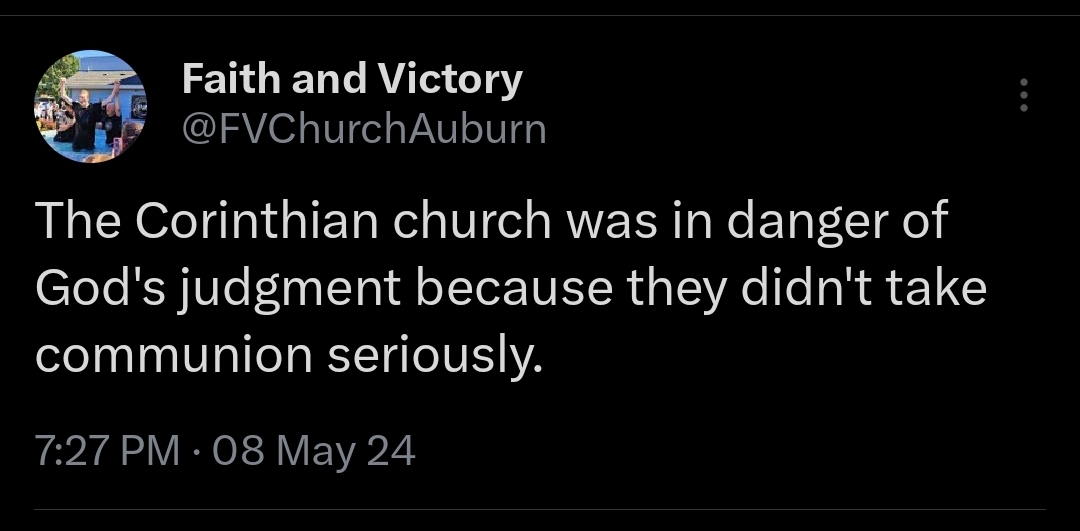
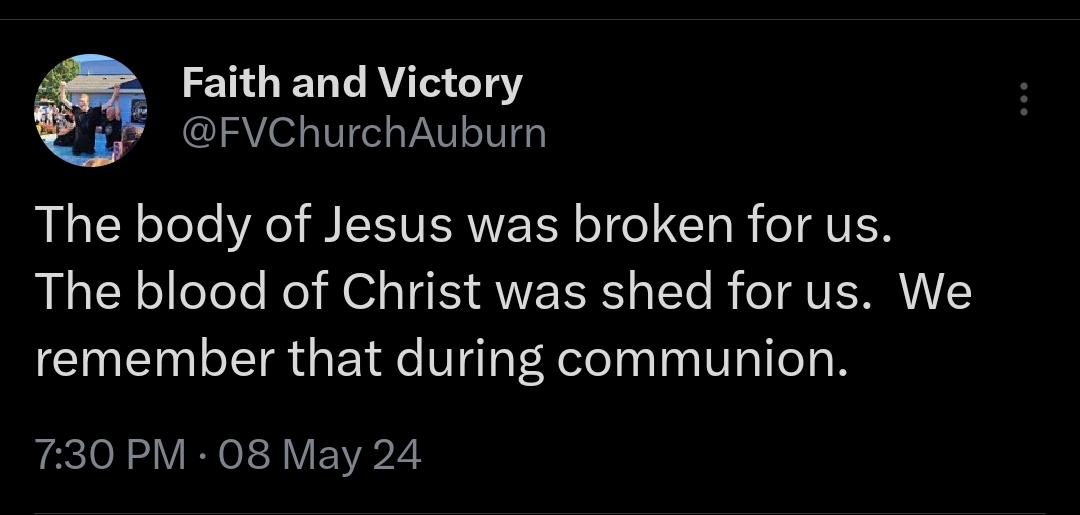
The church was in danger of God’s judgment for not taking the Lord’s supper seriously. They were told they needed to examine themselves in light of the seriousness and respect for Christ’s broken body and blood that was shed for the new covenant.
What is communion? The Last Supper, when communion was first instituted, was actually a Passover meal, when Jesus, together with the disciples, according to Biblical commands and Jewish traditions, celebrated the remembrance of Israel’s deliverance from Egypt to the Promised Land, beginning in the book of Exodus. It is called a Seder meal, done in remembrance of God’s deliverance and redemption of His people.
The breaking of bread and the drinking of wine were important parts of the Passover celebration. At the last Supper, Jesus took these important pictures and reminders of Israel’s deliverance from Egypt, and added to them the meanings connected with His own death on the cross for us.
This is My body: In taking the bread, we are called to remember Jesus’ body broken for you. The Passover meal featured unleavened bread, made without yeast both because yeast is a picture of sin and corruption in the Bible, and because in bread, yeast needs time to work – and in their haste to leave Egypt, the Israelites had no time to let their bread rise.
The unleavened bread used at a Passover meal had the scorch-mark “stripes” and holes from baking that looked like “pierce” marks. In the same way, the body of Jesus was broken for us. He was without sin (as the bread had no leaven), and His body bore stripes and was pierced (as the bread appeared to be). We are not eating the literal body of Jesus as some claim.
This cup is the new covenant in My blood: In receiving the cup, we are called to remember the blood of Jesus and the new covenant. The Passover meal featured several cups of wine, each with a different title. The cup Jesus referred to was known as the cup of redemption, and Jesus added to the idea of redemption from slavery in Egypt the idea that His blood confirmed a new covenant that changed our relationship with God. We are not literally drinking His blood
Jesus founded a new covenant, sealed with His own blood, even as the old covenant was sealed with blood.
Exodus 24:8 And Moses took the blood, sprinkled it on the people, and said, “This is the blood of the covenant which the Lord has made with you according to all these words.”
What is the new covenant all about? What things are we to remember in communion?
Communion is a serious rite given to the church. It is not to be treated lightly or irreverently. There are repercussions for being found guilty before the Lord and violating the blood of the new covenant. Communion is not for just anybody. It is only for those in Christ, which is why I believe it is never wise to give it out without doing some form of teaching on it.
We are to approach the Lord’s Supper with reverence and delight. Remember the fear of the Lord. Redemption produces in us awe. We are to ponder on the death of Christ, the sacrifice He paid, and the pain Jesus went through while taking my place on the cross and taking away the sin of the world. Communion is an act of worship. This act of worshiping God through the Lord’s Supper impacts and motivates us to be more thankful, more forgiving, more gracious and more committed to Jesus. This should be our mindset. I have 6 “R” words to help us to not be guilty of taking communion in an unworthy manner. The “how to” of communion:
#1 Remember. In 1 Corinthians 11 God gives us some instructions about the Lord’s Supper. Two times in verse 24 and 25 we are told to “do this to remember Me”. The Lord’s Supper is about remembering our Lord Jesus and His death.
To “remember” means much more than simply to bring something to mind, merely to recall that it happened. To truly remember is to go back in one’s mind and recapture as much of the reality and significance of an event or experience as one possibly can. It’s like remembering a significant moment.
I remember my day at the altar on a Wednesday night and my baptism on that next Sunday when God opened my eyes. I remember the fist time I was baptized in the Holy Spirit and spoke in tongues.
I remember when he healed my heart arrhythmia at an altar in Tennessee.
I remember what my life was like before Him and how I do not ever want to go back
When Jesus said, “Do this to remember me” this is what He was talking about. To remember Jesus Christ and His sacrifice on the cross. Remember His suffering and pain. Remember that God so loved the world that He gave.
When Jesus tells us to “do this to remember Me” He is telling us to think about the sacrifice He paid, the pain He went through for us, the greatness of Him taking up the cross that should have been for us. He wants us to remember this because it reminds us of how much He loves us.
Remember that I have been forgiven a great debt that I cannot repay.
Remember the mercy shown me.
Remember the blood that poured out to make me whole.
Remember the stripes He took for my healing.
If you need help remembering what a wretch you were and what He did for you, watch “The Passion” and this probably doesn’t even come close to the pain and suffering He endured for you.
Isaiah 53:5-8 NKJV 5 But He was wounded[a] for our transgressions, He was [b]bruised for our iniquities; The chastisement for our peace was upon Him, And by His stripes[c] we are healed.
6 All we like sheep have gone astray; We have turned, every one, to his own way; And the Lord [d]has laid on Him the iniquity of us all. 7 He was oppressed and He was afflicted, Yet He opened not His mouth; He was led as a lamb to the slaughter, And as a sheep before its shearers is silent, So He opened not His mouth. 8 He was taken from [e]prison and from judgment, And who will declare His generation? For He was cut off from the land of the living; For the transgressions of My people He was stricken.
#2 Repent. God wants us to use the Lord’s Supper as a time of examination.
“Therefore whoever eats this bread or drinks this cup of the Lord in an unworthy manner will be guilty of the body and [e]blood of the Lord. 28 But let a man examine himself, and so let him eat of the bread and drink of the cup. 29 For he who eats and drinks [f]in an unworthy manner eats and drinks judgment to himself, not discerning the [g]Lord’s body. 30 For this reason many are weak and sick among you, and many [h]sleep. 31 For if we would judge ourselves, we would not be judged.”
If we judge ourselves, we will not be judged. This means to submit our own condition to moral criticism. If we would exercise a strict scrutiny over our hearts and feelings, and conduct, and come to the Lord’s Table with a proper spirit, we should escape the condemnation to which they are exposed who observe it in an improper manner. If we would exercise proper “severity” and “honesty” in determining our own character, we should not expose ourselves to God’s displeasure and punishment.
God wants us to use the Lord’s Supper as a time of self-evaluation, examining our commitment to Him. Otherwise, we can take communion in an unworthy manner and bring judgment upon ourselves.
Hebrews 10:26-31 For if we sin willfully after we have received the knowledge of the truth, there no longer remains a sacrifice for sins, 27 but a certain fearful expectation of judgment, and fiery indignation which will devour the adversaries. 28 Anyone who has rejected Moses’ law dies without mercy on the testimony of two or three witnesses. 29 Of how much worse punishment, do you suppose, will he be thought worthy who has trampled the Son of God underfoot, counted the blood of the covenant by which he was sanctified a common thing, and insulted the Spirit of grace? 30 For we know Him who said, “Vengeance is Mine, I will repay,” [a]says the Lord. And again, “The Lord will judge His people.” 31 It is a fearful thing to fall into the hands of the living God.
Judge yourself hard so that you will not be judged. Examine your heart and your motives. There is always a Judas in the making, “Is it I?”
Psalm 139:23-24 Search me, O God, and know my heart; Try me, and know my anxieties;
24 And see if there is any wicked way in me, And lead me in the way everlasting.
Ask Him to reveal any idols, jealousy, greed, pride or selfish ambition. What actions are shaming His glorious name? Are you getting drunk and high and calling it good? BE honest with Him and yourself. This is the time to repent. You are not worthy enough to be in His presence, but He made a way for you to enter in and be forgiven of all your sin. Take the time and ask for forgiveness. He is faithful to forgive all our sins and cast them as far as the east is from the west. This is the time to be set free!
#3 Restore. Notice this section on the Lord’s Supper begins by addressing some divisions in the body of Christ.
“For first of all, when you come together as a church, I hear that there are divisions among you, and in part I believe it.” V.18
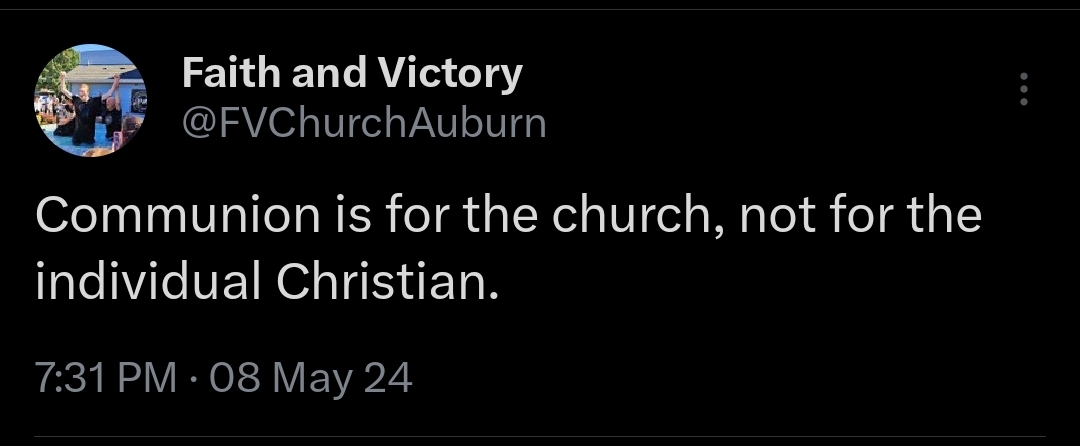
Paul begins explaining the Lord’s Supper by starting with church divisions and conflict among the believers. Paul knew that one of the purposes and effects the Lord’s Supper has when done correctly is restoration among God’s people. Communion is not just about you, it’s about you and the whole body.
“For he who eats and drinks [f]in an unworthy manner eats and drinks judgment to himself, not discerning the [g]Lord’s body.” Paul here is referring to the body of Christ, which is the church.
When the Lord’s Supper is taken with a right heart, unity and forgiveness will be the outcome. If the Lord’s Supper is done with the right attitude and mind, you should be motivated to seek forgiveness from those who you have hurt and give forgiveness to those who have hurt you. A remembrance of your forgiven sins should make you more gracious to others. It is also important to remember that Christianity is not an individual walk. What YOU DO affects the whole body. Your sin affects others. It is leaven and it spreads.
Paul uses a yeast metaphor concerning Passover and the church earlier in his letter:
“Your boasting is not good. Do you not know that a little leaven leavens the whole lump? Cleanse out the old leaven that you may be a new lump, as you really are unleavened. For Christ, our Passover lamb, has been sacrificed” (1 Corinthians 5:6–7, ESV).
Here, “leaven” represents sin. Paul wants to protect the church from the disastrous consequences of moral corruption. Their arrogant attitude of tolerating sin in the church posed a severe threat. Allowing one believer to continue unchecked in a blatant transgression would have a devastating impact on the entire church. Paul asks, “Don’t you realize that this sin is like a little yeast that spreads through the whole batch of dough?”
The church must deal with the person’s sin. A single member’s sin affects the entire body because we are all collective parts of one whole.
As you take the Lord’s Supper you need to ask God, “God, is there anyone I have hurt and need to ask their forgiveness?” Is my sin affecting the whole? If there is then you need to make it right as soon as you can. As you remember the death of Christ and think about how it restored and reconciled you to God, it should drive you to restore and reconcile with others and to consider others better than yourself.
#4 Rededicate. The Lord’s Supper is a reminder to us that we are in covenant with the Lord. Take a close look at
1 Corinthians 11:25 “This cup is the new covenant between God and His people – an agreement confirmed with My blood. Do this to remember me as often as you drink it”
Notice Jesus referred to a “covenant.” This covenant has two sides. In covenants, there is an exchange of persons and stuff. Ex: pastor Christian would come to our house as a teen and eat and drink everything because we were in covenant together. This meant that all that we had was his and all that he had was ours. Who benefitted the most from this covenant? He did. WE were married adults with a home, food, cars, money. HE was a teen with nothing but a ran down old car.
WE are in a covenant with the Lord. This means that all that I am belongs to Him and all that HE has belongs to me. It is not very fair, but He established the rules of the covenant.
I trade in my sins for His righteousness.
I trade in my ashes for His beauty.
I trade in my brokenness for His healing.
When you enter this covenant at salvation God guarantees your sins have been paid for and forgiven by the blood of Jesus. You become a new creation, a child of God adopted into His family, a co-heir with Jesus.
The other side of this covenant is obedience. When you accept Christ as the Lord of your life you are saying, “I will obey You, Lord. You are my God and I will submit to You.” Part of the Lord’s Supper is to remind us as believers that when we were saved we entered a covenant with God saying I will follow your ways. So as God’s people the Lord’s Supper is a time to look up to God in our hearts and rededicate ourselves to the covenant that we have with Him knowing that He will always keep His end of the covenant whenever we sin.
Psalm 89:34 My covenant I will not break, Nor alter the word that has gone out of My lips.
WE have a hope and a promise that He will go with us and see us through this life until the end of our days. Covenants are serious. We rededicate ourselves to the covenant promise.
#5 Reach out. The Lord’s Supper also reminds us to reach out and proclaim Christ to those around us. Look at verse 26, “For every time you eat this bread and drink this cup, you are announcing the Lord’s death…”
The message of the cross and the Lord’s death is not only for us to remember, but it is for us to proclaim, preach, teach, share, and testify. The Lord’s Supper is an act of proclamation.
Proclaim is the same word translated “preach” in other places. When we take communion, we preach a sermon to God, to the Devil, and to the world who watches.
When you participate in it you are saying I believe Jesus died for my sins. I believe He rose again. I believe that my sins have been paid for by the death of Jesus Christ on that cross. I believe I have eternal life because of Christ. When you take the Lord’s Supper you are making a statement to those sitting around you and to the world that you are a follower of Christ and you are not ashamed of Jesus.
“As you break bread and bow your heart before Him, what sort of sermon are you preaching? Often we have broken bread together around the Lord’s table, and then we have gone out to do just what those disciples did – we have denied Him.” (Redpath)
#6 Rejoice. The Lord’s Supper brings our attention to the fact that someday Christ will return to gather His people together. Look carefully at verse 26, “For every time you eat this bread and drink this cup, you are announcing the Lord’s death until He comes again”
We proclaim the cross of Calvary every time we take the Lord’s Supper, but it is always in the shadow of Christ coming back.
The Bible teaches that Jesus Christ will return.
1 Thessalonians 4:16 “For the Lord Himself will descend from heaven with a shout, with the archangel’s voice, and with the trumpet of God, and the dead in Christ will rise first. Then we who are still alive will be caught up together with them in the clouds to meet the Lord in the air; and so we will always be with the Lord” (HCSB).
The Lord’s Supper looks forward to the coming of Jesus, and the marriage supper of the Lamb
Revelation 19:9 Then he said to me, “Write: ‘Blessed are those who are called to the marriage supper of the Lamb!’ ” And he said to me, “These are the true sayings of God.”
If the Lord’s Supper is done right in your heart, you should be more excited about the return of Christ. Communion is not just about the death of Christ, but about the reign of Christ. Jesus died on the cross so that He could resurrect from the grave. He resurrected from the grave so that He could ascend to the Father. He ascended to the Father so that He could give us the Holy Spirit until the time when He could come back again for His people.
He is coming back for me! Glory Hallelujah! Do this is remembrance of HIM!
For more sermons please visit our SERMON PAGE
Please subscribe to our YOUTUBE PAGE